

Konvoi Workshop: Your Own Garage, Fully Planned.
Posted: 2026 | Category: Fleet Automation
The Garage Behind the Fleet
A transport company with forty trucks often has its own workshop. Three or four mechanics, a lift, a wall of shelves with filters and brake pads, a drum of engine oil, and a planner who keeps the whole thing in their head.
Konvoi already knew everything about those trucks: where they are, how many kilometres they have done, which document expires next month, and the damage a driver reported this morning with three photos. Then all of it stopped at the workshop door. The repair went onto a whiteboard, the parts into a notebook, the hours onto a timesheet that nobody adds up, and the cost of the repair never came back to the truck.
Konvoi Workshop is the software for that garage.
One Board, the Whole Garage on It
The planning board holds everything the planner used to juggle: the work orders, the mechanics and their teams, who is on leave, sick or on training, the working schedules (38 hours, 40 hours, four days out of five, two-week rotations, closed days), and the parts that are on their way with the date the supplier promised.
Drag a job onto a mechanic, or give it to a team. The hours on the work order fill themselves from the board. When the mechanics clock in on the tablet, the board shows who is in.
Every Job on One Work Order
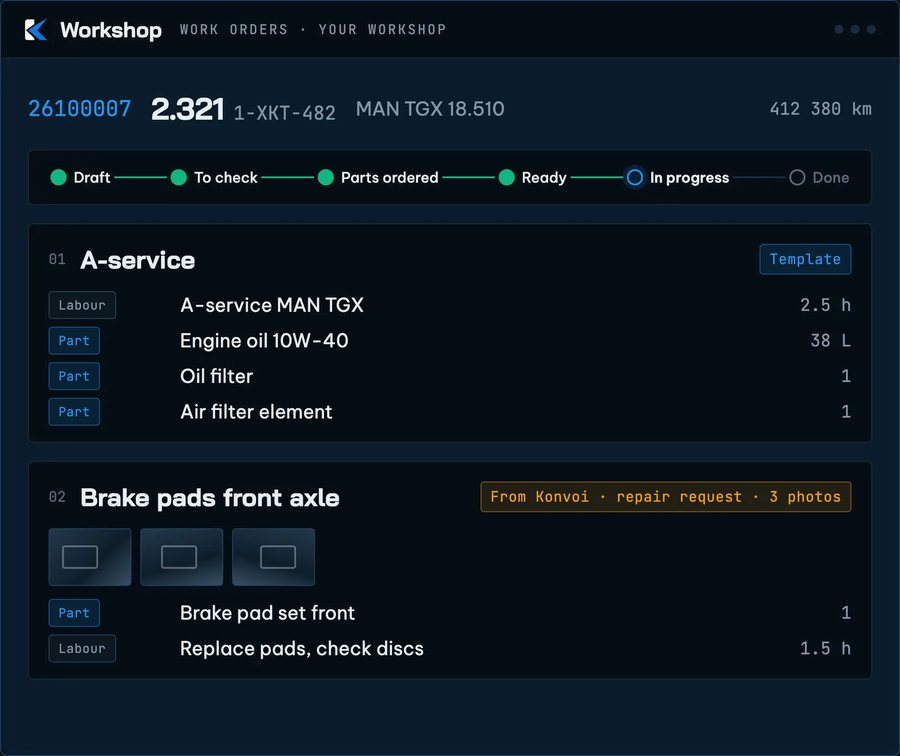 Draft, to check, parts ordered, ready, in progress, done. The repair request from Konvoi arrives with the driver’s photos.
A work order goes from draft to done through a fixed set of steps, and every job on it carries its own labour and parts. Job templates and parts kits per vehicle model mean an A-service on a MAN TGX starts with the right oil and the right filters already on it. Service plans by kilometres or by date put the next service in the inbox before anyone has to remember it.
Some workshops prefer paper. So every work order prints: one sheet per job, the fleet number in big type, and a code the tablet scans.
Every Part on Its Shelf
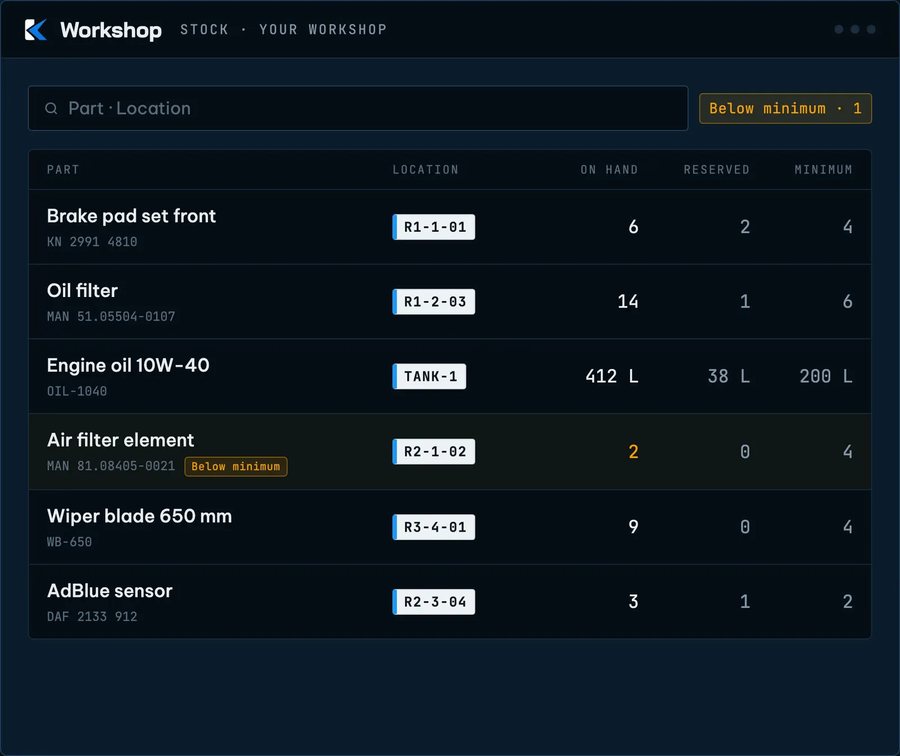 On hand, reserved and minimum, per bin. The air filter is below its minimum, so it is already on the order list.
Stock lives in locations, areas, racks and bins, each with a printed label. Every movement is booked in a ledger, and parts go onto a work order at what they actually cost. Counting is scanning a bin. Existing stock lists and bin codes can be imported as they are.
Purchasing works from one list: the parts a job needs and the parts below their minimum. Workshop makes a draft order per supplier, with their prices and delivery times, and sends it by email. What arrives is reserved for the work order it was ordered for. A mechanic who needs a part takes a photo on the tablet and asks for it.
Built for the Tablet Next to the Truck
Mechanics sign in with a PIN, start and stop a clock per job, tick off the checklist, take photos and scan the shelf when they take a part. The workshop Wi-Fi is rarely good, so the tablet keeps working without it and sends everything when it is back, without booking anything twice.
At the end of the week, the hours add up: time present next to time on work orders, per mechanic. People in the warehouse can use the same tablet as a time clock.
The Same Trucks, Both Ways
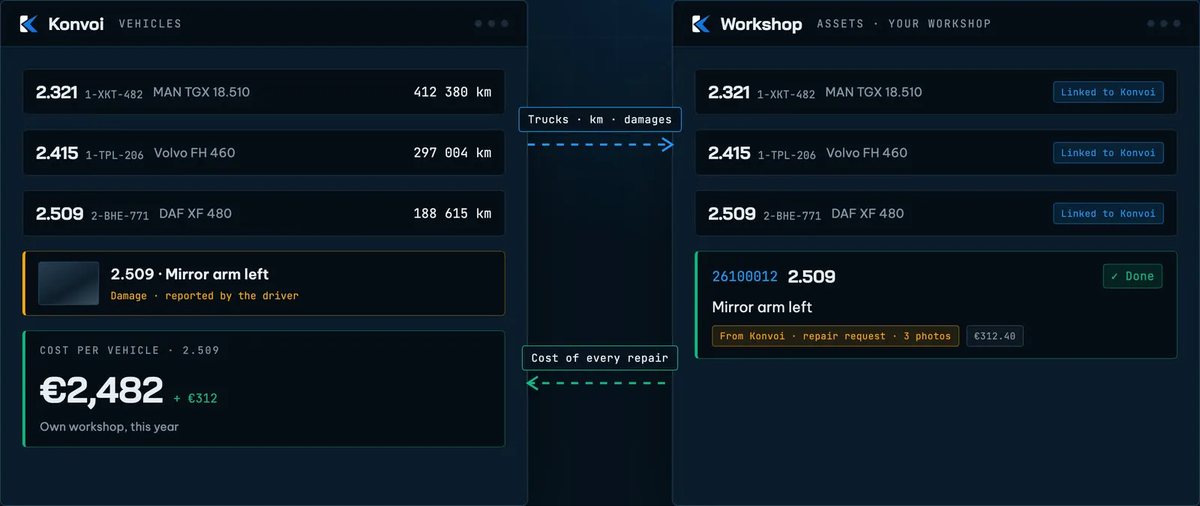 Trucks, kilometres and damages go into Workshop. The cost of every repair comes back to the truck in Konvoi.
Linked to Konvoi, the vehicles, plates, fleet numbers and kilometres come in on their own. A damage reported in Konvoi becomes a draft work order with the driver’s photos. Expiring documents and due maintenance show up as signals. And every finished job adds its cost to that vehicle in Konvoi, so “what did this truck cost us this year” finally includes the work done in your own garage.
Workshop also runs without Konvoi: import the vehicles from a spreadsheet and start.
Set It Up by Talking to It
Getting a garage into new software usually means a week of typing stock lists. Workshop has its own MCP server, so you can connect Claude or ChatGPT and hand it what you already have: a stock list, bin codes, a supplier’s price list, the list of mechanics. It proposes an import, and a person approves it in Workshop. The assistant never changes anything on its own.
Built Like Everything Else We Build
Workshop is its own product with its own database, and it talks to Konvoi only through Konvoi’s public Partner API, the same way any other workshop software would. A test fails the build if it ever reaches around that. Every gap we found in the API was fixed in the API itself, so every other system benefits too. How and why we did that is in the blog post.
Results
- One planning board for work orders, mechanics, leave, schedules and parts on order
- Work orders from templates and kits per vehicle model, printed or on the tablet
- Stock as a ledger: every movement booked, parts at real cost, counting by scanning a bin
- Purchasing from one list, draft orders per supplier, arrivals reserved for their job
- Linked to Konvoi both ways: trucks, km and damages in, repair costs back to the vehicle
- In English, Dutch and French, on the web and on the tablet
Running your own garage? See Konvoi Workshop or tell us how your workshop runs.